Identity: Designing a Home That Feels Like You
Content
Walk into enough beautifully designed homes and you begin to notice something: Many of them are stunning. The materials are luxurious. The furnishings are thoughtfully selected. Every object appears intentional. And yet, despite all of that, they often feel strangely interchangeable. They could belong to almost anyone.
This isn't a criticism of beautiful design. Beauty matters. It always will. But beauty alone cannot explain why some homes feel deeply personal while others feel like carefully curated showrooms. Nor can it explain why one home feels unforgettable while another, though objectively lovely, leaves little lasting impression. The difference is identity.
Within the Joyful by Design Framework, identity is the first pillar because it is what transforms a well-designed house into a home that couldn't belong to anyone else.
What Do We Mean by Identity?
Identity is the personality, character, spirit, and story of a home. You might also think of it as the through line that connects every design decision. People sometimes call this a "theme," though I use that word cautiously. I don't mean a theme in the Disneyland sense, where every object reinforces a literal concept. Unless you're intentionally designing an immersive experience, identity is rarely about icons or motifs. It is far more subtle than that.
Identity is the spirit of a space. It is the invisible thread that connects architecture, materials, colors, furnishings, artwork, and objects into something that feels unmistakably yours.
This is also why identity is so often confused with style. People ask, "How do I find my interior design style?" or "Should my home be modern, traditional, or mid-century?" They're asking the right question in the wrong language. Style is simply a vocabulary. Identity is the story — one exists to serve the other.
It Begins With People, Not Rooms
One of the first questions homeowners often ask is, "How do I want my living room to feel?" It's a reasonable question and one that’s incredibly important when we get to the colors and fabrics portion of things, but it's not where I begin. Identity doesn’t starts with the room, it starts in the soul. It starts with the people.
When I'm starting with a new client, I'm much less interested in their favorite sofa than I am in their favorite memories.
Where did they grow up?
What is their family history?
Where have they lived?
What trips changed them?
Which artists do they return to again and again?
What colors have always spoken to them?
What makes them feel energized?
What leaves them feeling overwhelmed?
At first glance, these don't seem like interior design questions at all. They're questions about identity. The answers are clues. Individually they may not tell us much, but together they begin to reveal patterns. My job isn't simply to collect preferences. It's to understand what makes someone who they are.
One of my deepest held beliefs about homes if that a home shouldn't simply look beautiful. It should reflect the people who live there.
It’s Is an Act of Self-Discovery
Perhaps the most surprising part of the design process is that it often becomes a process of self-discovery. People come to me believing they're hiring someone to help them choose furniture, finishes, and paint colors. Instead, they often leave with a deeper understanding of themselves.
Design asks us to pay attention to the things we've always been drawn toward but never fully understood. The places that continue to live in our memory. The objects we can't explain why we love. The stories that continue to inspire us. This isn't about inventing a new identity. It's about uncovering the one that has been there all along. That process is creative, it is deeply personal. It’s an act of self-expression and, in many ways, it is an rite of passage to becoming the person you are meant to be. Our homes are one of the few places where we have the freedom to give physical form to the lives we're living and the people we're becoming. There is something profoundly romantic about it — the belief that a meaningful life is worth expressing.
Collect First. Interpret Later.
One of the biggest mistakes people make is trying to edit before they've discovered what they're actually trying to say.
When I begin creating the identity for a home, I have one counter-intuitive rule: No interiors. At least not in the beginning. No living rooms, no kitchens, no Pinterest-perfect bedrooms. The moment you begin collecting photographs of interiors, your brain starts solving a decorating problem instead of an identity problem. It starts thinking literally and we aren’t ready yet. Instead, collect photographs of anything that genuinely moves you:
Memories
Landscapes
Architecture
Art
Animals
Travel
People
Craft
Historic places
Don't ask whether any of it "goes together," or what design style it belongs to — that’s how spaces end up falling flat.
A Personal Example
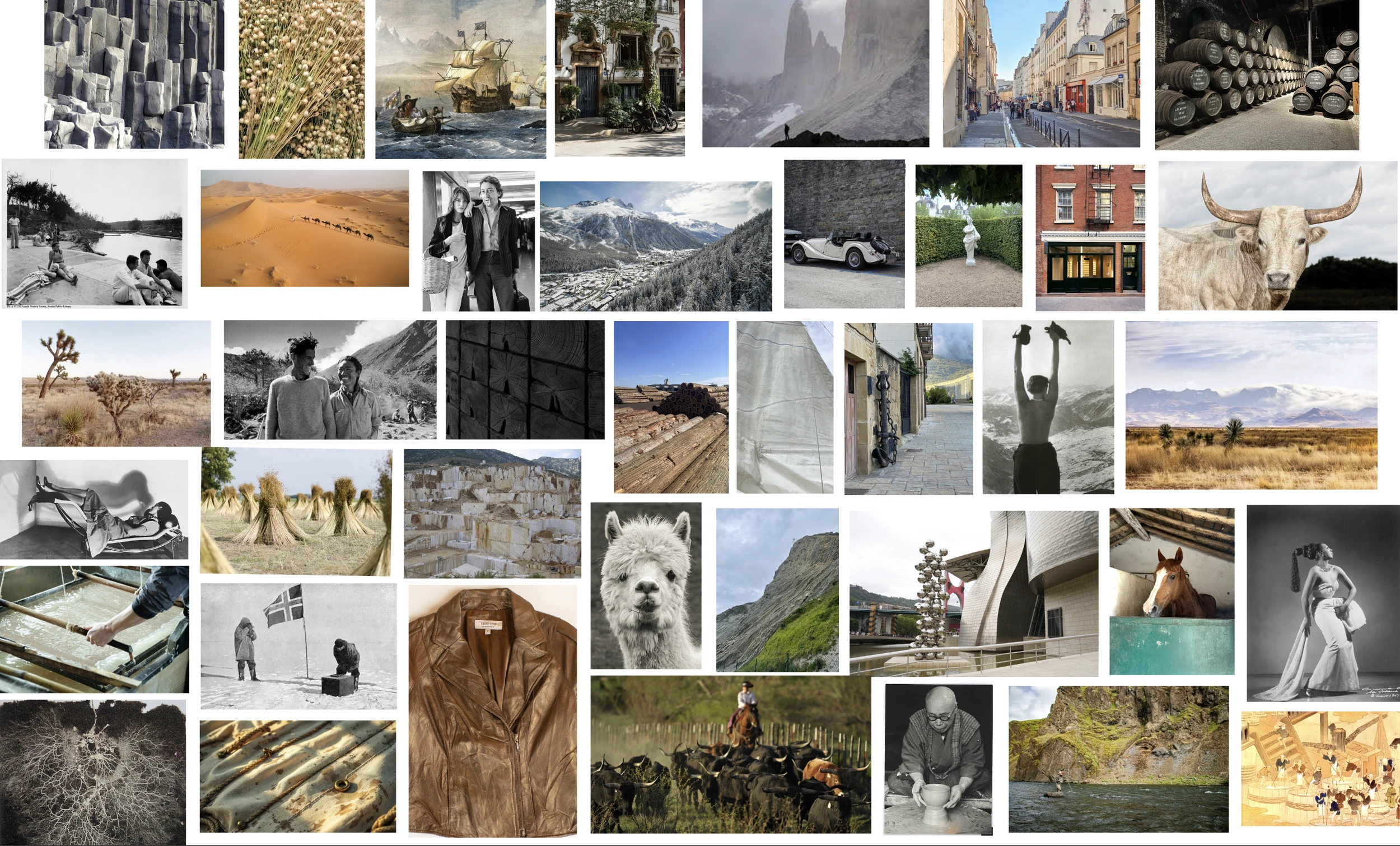
The image below is one of my own inspiration boards. If you take each image on its own it feels random: there are sailboats crossing rough seas, Sir Edmund Hillary, horses, streets, deserts, old clothes, volcanoes, alpacas, musicians… you get the point. Many of these photos came from my own camera roll. When I opened the folder and began skimming through they made me grin, so I put them onto the board.

If I had started by asking, "What interior design style am I creating?" this board never would have existed. I would have filtered out half of these images because they didn't match. Instead, I collected first.
Only after pulling these together did the pattern begin to emerge. The throughline: adventure, curiosity, craftsmanship, resilience, human accomplishment. Honest materials, places shaped by time, a reverence for the natural world.
Those aren't decorating themes, they're values. Values make far better design guides than styles ever will. Once those values become clear, they begin to influence every design decision. Materials that feel authentic rather than manufactured. Objects that bear the hand of the maker. Spaces that feel grounded, reverent but bold, courageous, traditional but not precious, adventurous.
Identity Is Not “Style”
One of the most common misconceptions in interior design is that every room needs to fit neatly into a single historical style. Mid-century Modern, English Country, Traditional, Contemporary — but real homes—and real people—are rarely that one-dimensional. We are not recreating a vignette from a design history museum. We are creating a home for a living, evolving person.
A thoughtful home borrows freely from different periods, cultures, and movements whenever those pieces help tell the same story. A nineteenth-century antique might sit beside a contemporary sofa. A handcrafted ceramic lamp may live beneath a modern abstract painting. An eighteenth-century portrait may hang in a minimalist room.
What unites them isn't the decade they came from. It's the identity they express.
The question is never,"Do these pieces come from the same era?" The better question is,"Do they tell the same story?"
Ironically, this often creates homes that feel far more cohesive than those designed around a single style. Their cohesion doesn't come from historical accuracy. It comes from a consistent identity.
The Throughline
Once identity becomes clear, every other design decision becomes easier. Not because the choices become obvious, but they become meaningful. Identity becomes the lens through which every decision is viewed. Materials, artwork, furniture, architecture, color — identity creates cohesion without feeling canned. It gives personality and soul, without literally putting photos of you and your family all over the walls.
It is the quiet thread woven through an entire home, allowing every room to have its own personality while still feeling unmistakably connected to the whole.
Identity is How a House Becomes a Home
Hotels can be beautiful. Showrooms can be beautiful. Museums can be beautiful. But none of them know who you are. Your home must.
The identity of a home recognizes something profoundly human: no two people are wired the same way. We are inspired by different stories, energized by different places, comforted by different colors, and shaped by different experiences. No two identities are alike because no two lives are alike. That is precisely what makes them worth expressing. A house becomes a home not because it's decorated beautifully, but because it expresses something that couldn't belong to anyone else.
The first step in designing a home that reflects you isn't choosing better inspiration images. It's becoming a more attentive student of yourself.
The most meaningful homes are not designed around a trend, a style, or a period in history. They are designed around people.